Think Networks Not Leaks

Traditional leak repair starts at the pipe. WateRecoup starts at the network.

We identify the highest-loss zones, prioritize interventions where they deliver the greatest impact, and systematically recoup water across entire distribution systems one pipe section at a time.

How Our Approach works

Network Analysis
01

Network Analysis

WateRecoup applies a system-wide approach to water loss restoration. Rather than addressing individual leaks, we work across entire networks, zones, or multiple DMAs, progressing methodically from the system level down to individual pipe sections.

Zone Prioritization
02

Zone Prioritization

The process typically begins with the identification and prioritization of areas with the highest water loss potential. This may be based on established operational tools such as Minimum Night Flow (MNF) analysis, step testing, and existing engineering and operational data, complemented by WateRecoup's own leakage indication and assessment methodologies, including Leakage Indication Testing (LIT). Together, these inputs enable utilities to focus first on zones where restoration delivers the greatest immediate and long-term impact.
Section Isolation
03

Section Isolation

Once priority zones or DMAs are defined, individual pipe sections are strategically isolated to allow controlled, targeted intervention, establishing the conditions required for precise treatment, accurate water-loss measurement, and reliable verification.
Treatment
04

Treatment

Each isolated pipe section is treated sequentially utilizing WateRecoup's Revipipe technology, addressing multiple leakage points, joints, and defects within the treated pipe section, all in a single intervention.
Verification
05

Verification

Each treated section undergoes baseline measurement and post-treatment verification, ensuring full control, traceability, and auditable results. While the intervention is executed at the pipe-section level, performance is validated at the zone and DMA scale, demonstrating cumulative and scalable recovery across the network.
Outcome
06

Outcome

This structured, top-down execution enables WateRecoup to operate efficiently at city scale, transforming chronic water loss into a recoverable and sustainable water source. A direct outcome of this approach is a substantial reduction in physical non-revenue water, often driving network-level losses toward single-digit percentages, alongside improvements in supply reliability, operational efficiency, energy recouping, and overall system resilience.

Key Advantages of Our Approach

Approach feature icon

Immediate Capacity Gain

Instead of expanding abstraction, drilling new wells, or building new treatment plants, we recoup water already produced and paid for. This delivers meaningful capacity increases from day one, without new environmental burdens.

Approach feature icon

Scalable, Systemwide Restoration

Our method enables full-network coverage in just three years for a typical mid-size city. Restoration is planned section by section, allowing utilities to continuously monitor progress and quantify recovered supply.

Approach feature icon

Cost-Effective & Resource-Efficient

WateRecoup restores water at a fraction of the cost of reclamation, reuse, or desalination. No additional treatment capacity or energy-intensive processes are required.

Approach feature icon

Minimally Disruptive Implementation

The process works alongside existing infrastructure with minimal enabling works and limited service downtime. Cities retain full operational continuity while gaining new water supply from day one.

Immediate, Verified Results

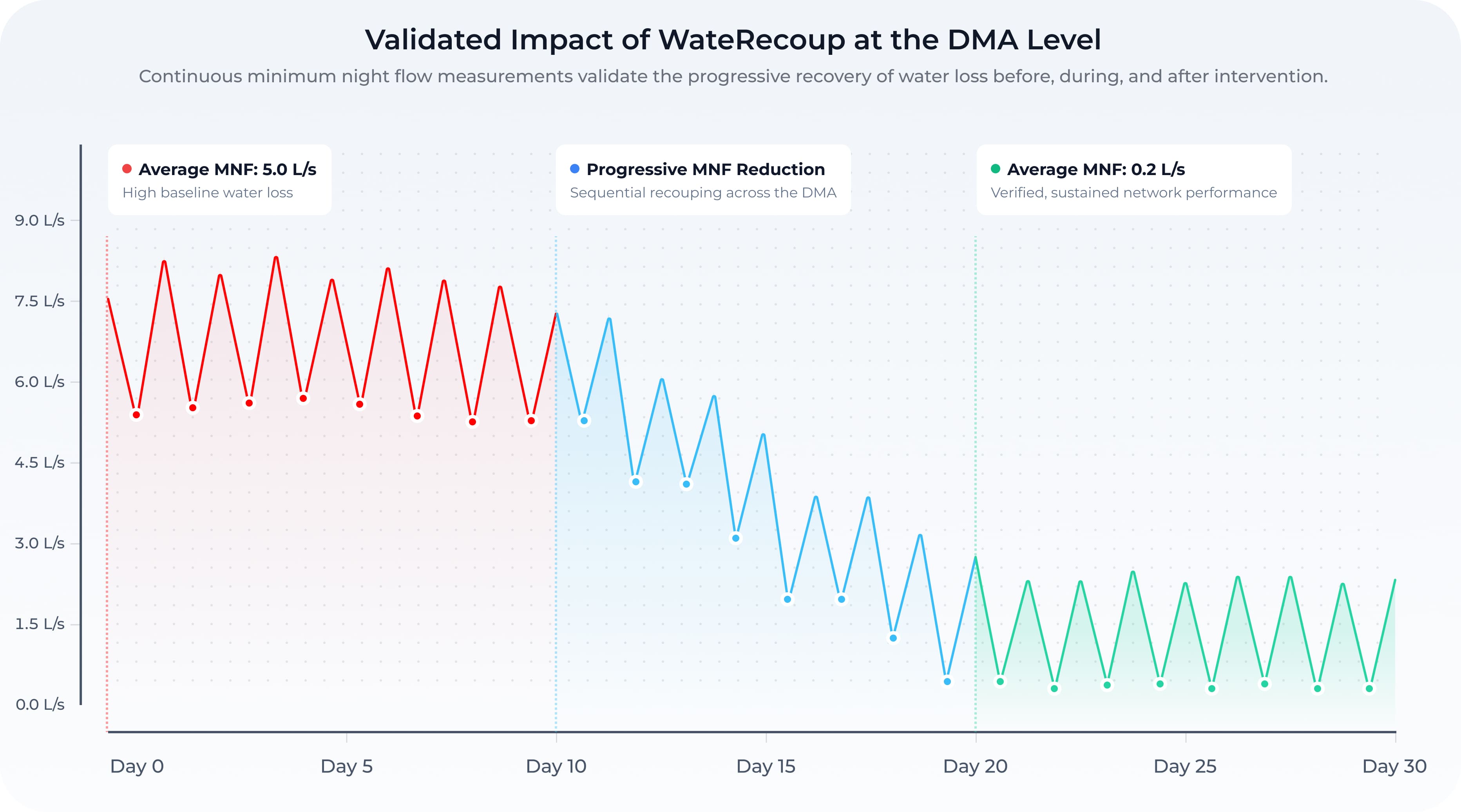
We deliver verified pre- and post-intervention leakage readings that demonstrate measurable reductions in water loss at the pipe section and DMA level. By collecting and analyzing high-resolution network data throughout implementation, we provide utilities with precise leakage quantification and continuous monitoring of project progress.

Flow levels in DMA before/after WateRecoup intervention

Average Minimum Night Flow (MNF) = Leakage Levels in District Metered Area (DMA)

PHASE 01

Prior to Intervention

High Baseline Water Loss (5 L/s)

  • Baseline DMA leakage levels establish the reference point for intervention.
  • Elevated night flow indicates significant recoverable water loss.
  • Priority sections are identified for targeted restoration.
PHASE 02

WateRecoup Intervention Phase

Progressive WateRecouping across the entire DMA

  • Pipe sections are treated sequentially using ReviPipe technology.
  • DMA flow rates are continuously monitored throughout implementation.
  • Each completed intervention contributes to cumulative water supply recovery.
PHASE 03

Verified Post-Intervention

Confirmed recovery of previously lost water supply

  • Stable post-intervention flow of 0.2 L/s confirms sustained performance.
  • Pre- and post-intervention measurements verify the recovered water supply.
  • Utilities can independently monitor long-term results using their own operational data.